
When an asset's price rises, the consensus belief is that it will rise forever. When it falls, the market quickly assumes the asset is permanently impaired. Investors frequently confuse a standard cyclical correction with a structural demise, and today, we are seeing this exact pattern play out in Bitcoin (BTC).
Following an over 45% decline from its October highs and a sharp compression in volatility, the prevailing narrative is that Bitcoin has been permanently tamed and the once widely held "digital gold" thesis must now undergo reassessment.
At Privatus Capital, we believe this consensus view misses the broader picture. Rather than signaling demise, the data points to something far more consequential: a fundamental transition in market structure. This piece explores the growing, and ultimately unsustainable, divergence between synthetic market exposure (paper claims) and the asset's strictly scarce physical supply.
I. The Illusion of Supply
Futures and options do not literally print new Bitcoin. They create synthetic exposure: financial contracts where both counterparties take on risk without any underlying delivery. But the practical effect on price discovery is the same: they create the illusion of infinite liquidity when the opposite exists.
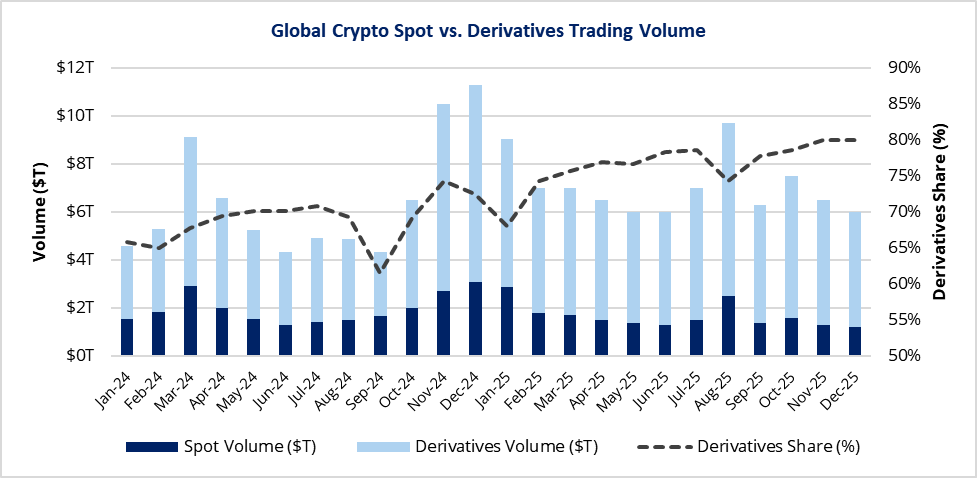
Over the last 18 months, Bitcoin's price discovery mechanism has migrated decisively from the spot market (physical claims) to this synthetic layer. The numbers are not subtle. So much so that in February, the CME Group (the world's leading and most diverse derivatives marketplace) announced plans to launch 24/7 trading for its crypto derivatives, citing record demand. The CME alone processed $3 trillion in crypto notional volume in 2025, with average daily volume up another 46% year-over-year so far in 2026.1
Sources: CCData, CryptoQuant, CoinGlass, CoinGecko
Fig. 1: The Migration of Price Discovery
With derivatives now accounting for nearly 79% of all crypto trading volume, this massive synthetic layer acts as a buffer, absorbing institutional inflows without triggering an immediate price response in the underlying asset. Financial institutions are literally upgrading their infrastructure to run around the clock just to handle the volume of paper being traded.
Put simply: the market is trading "IOUs" against a strictly scarce physical asset. This dynamic suppresses price discovery in the short term, but it is building a structural imbalance that must eventually force a physical reconciliation.
II. The Structural Precedent of Gold
This is not just a theoretical assumption. The gold market provides a direct historical precedent.
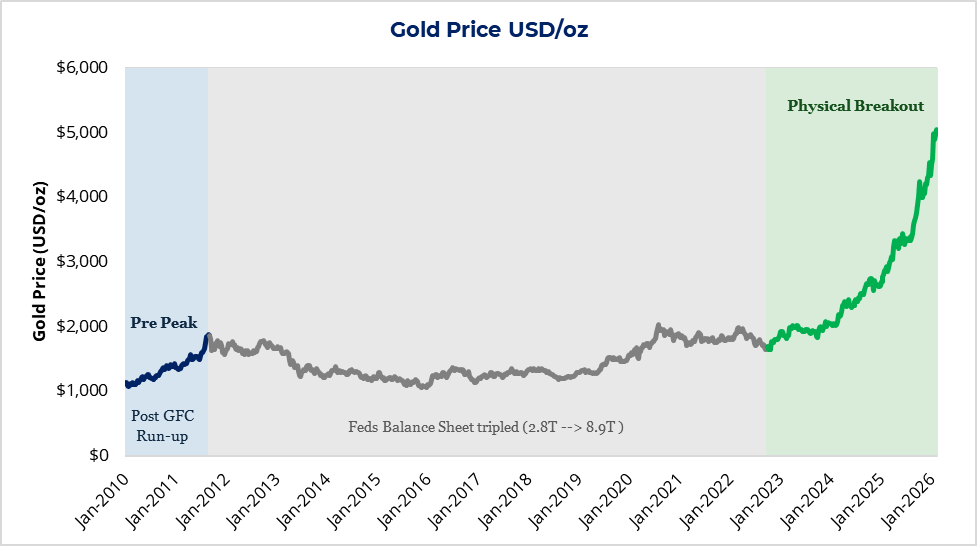
From 2011 to 2022, gold prices were range-bound despite sustained monetary expansion by global central banks. The mechanism was identical: the "paper gold" derivatives market swelled to an estimated $200–$300 trillion, creating a synthetic-to-physical multiple of 18x to 27x.2 Physical scarcity was real. The market simply couldn't see it through the wall of paper.
Sources: TradingView (TVC:GOLD)
Fig. 2: The Gold Precedent
Then the dynamic reached its structural limit. When large institutional buyers (primarily central banks) shifted their preference from holding synthetic exposure to demanding physical possession, the paper market could no longer absorb the pressure. The repricing, when it came, was violent.
The lesson is quite straightforward: paper markets can obscure physical reality for extended periods, but they cannot manufacture physical supply. Rather than invalidating the "digital gold" thesis, Bitcoin's current price action suggests it is actually following gold's structural playbook, just on a compressed timeline.
III. The Mathematics of Scarcity
Here is where Bitcoin's setup becomes more acute than gold's has ever been.
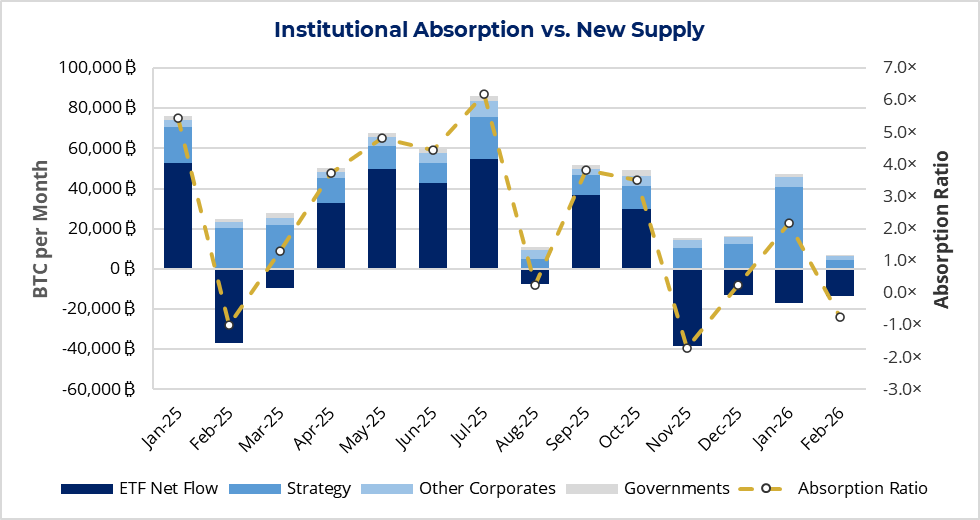
While the synthetic market continues to expand, the actual deliverable float of the underlying asset is actively shrinking. Throughout 2025, institutional vehicles absorbed an average of 3x the amount of newly mined coins. During peak demand periods, this ratio surged to 6x, with institutional appetite outstripping new issuance by a factor that simply cannot persist without consequence.
Sources: Farside Investors (ETFs), Strategy 8-K filings, BitcoinTreasuries.NET, Bitcoin protocol
Fig. 3: The Unsustainable Deficit
As of February 2026, the combined holdings of ETFs, corporate treasuries, private firms, and sovereign governments have reached approximately 3.69 million BTC, representing roughly 18.5% of total circulating supply.3
The market is experiencing an unprecedented mathematical collision: a shrinking denominator of liquid supply meeting an expanding numerator of institutional mandates. Every allocation systematically migrates high-velocity coins into slow capital (cold storage, fiduciary custody, sovereign reserves). This is creating a structural vacuum where the available float will eventually be unable to settle the demand stacking above it.
IV. The Bear Case and Intellectual Honesty
While the mathematical thesis is compelling, an objective risk assessment is the foundation of institutional conviction. To maintain analytical integrity, three primary "bear case" vectors must be evaluated.
- Macro Liquidity. Global liquidity remains the primary headwind. If central bank tightening persists, the market's deep synthetic layer (cash-settled derivatives, re-hypothecated vehicles) has the capacity to absorb spot demand through paper settlement for longer than anticipated. However, this buffer is finite. Unlike traditional commodities where elevated prices incentivize miners to extract more physical supply, Bitcoin's issuance is programmatically locked. Macro headwinds can delay the timeline of price discovery, but they cannot manufacture new supply to permanently satisfy ongoing accumulation.
- Structural and Regulatory Risk. Bitcoin does not yet possess a central bank buyer of last resort. A systemic failure within the ETF custodial architecture or a regulatory shock could trigger a sharp confidence crisis. That said, the current phase of institutionalization is itself a mitigant. Trillions in fiduciary and sovereign capital now share a vested interest in custodial security and regulatory clarity. The sheer volume of institutional exposure effectively compels rapid resolution of technical hurdles, as a systemic failure would now inflict damage on the traditional financial system itself.
- Quantum Computing. While historical estimates suggested breaking Bitcoin's ECDSA cryptography would require hundreds of millions of physical qubits, recent algorithmic optimizations have drastically lowered that threshold. With today's leading machines already demonstrating arrays of 1,000 physical qubits alongside critical breakthroughs in error-correction, major quantum firms and government agencies now project a reliable mathematical breach could occur between 2028 and 2033. Furthermore, as industry analysts like Nic Carter have highlighted, roughly one-third of all circulating Bitcoin currently sits in quantum-vulnerable addresses.4 This dormant capital acts as a massive, multi-hundred-billion-dollar "bug bounty" that heavily incentivizes both private and state-sponsored quantum R&D. Consequently, fiduciary allocators may divest or force action based on perceived vulnerability well before an actual breach occurs. If Core developers fail to quickly prioritize a quantum-resistant migration path (such as advancing the opt-in framework proposed in BIP-360), major institutional holders may eventually leverage their fiduciary mandates to force a protocol upgrade or divest completely to protect their interests.5
V. The Coiled Spring
One critical error allocators make is assuming Bitcoin's maturation will follow the slow, multi-year timeline of gold. While physical gold markets reconcile at the speed of logistics and shipping, Bitcoin reconciles at the speed of software. The timeline for the paper market to collide with physical scarcity will be highly compressed.
Consequently, the recent market correction should not be misinterpreted as a failure of the "digital gold" thesis. It was a standard, mechanical liquidation of synthetic leverage, clearing over $40 billion6 in open interest from the system. The paper leverage has reset. The structural supply deficit, however, has not.
Sources: Binance (BTCUSDT daily), S&P (SPX daily), FOREXCOM (XAUUSD daily), aligned on SPX trading days
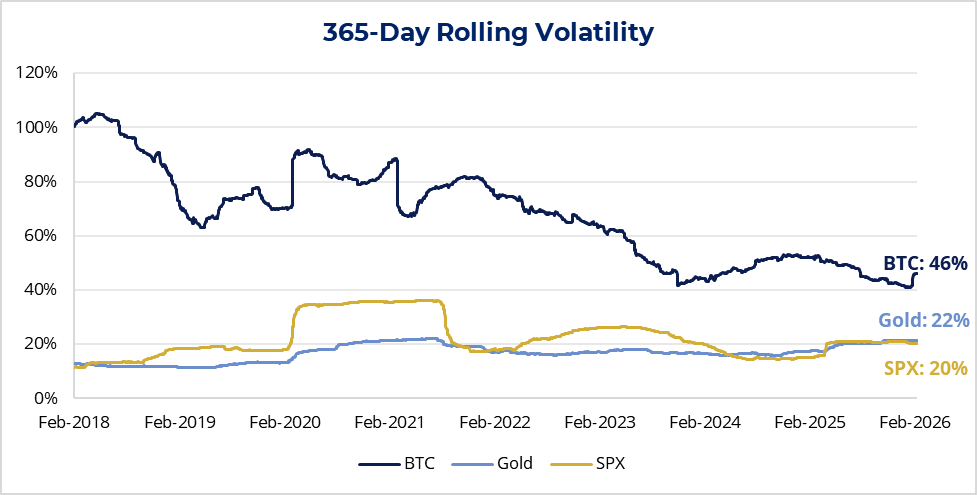
Fig. 4: The Maturation of the Asset Class
The evidence of this structural tension lies in the data: despite the massive clearing of leverage, volatility remains historically suppressed. While we expect Bitcoin's baseline volatility to gradually decline as the asset class matures, the current extreme compression is an illusion of calm. Driven by a shrinking physical float, this low volatility acts as a coiled spring. The longer the paper market delays price discovery, the more violent the eventual expansion will be.
Conclusion
While Wall Street can engineer infinite synthetic exposure, they cannot print the underlying asset.
We view the consensus that Bitcoin has been permanently tamed by institutional paper as a fundamental misreading of market mechanics. The synthetic layer has not neutralized scarcity. It has merely delayed the market's ability to price it. When physical settlement demand overwhelms this buffer, the repricing will not arrive at the pace of physical logistics. It will arrive at the speed of digital liquidation engines.
There is a deeper irony here worth noting. The very institutions building this paper architecture are inadvertently proving the original thesis: that a monetary asset governed by code rather than committees cannot be diluted through financial engineering. It can only be obscured temporarily. The protocol does not care about the paper market above it. It simply continues to issue 3.125 BTC per block, indifferent to the trillions in synthetic claims stacked on top.
The question for allocators is no longer whether this reconciliation occurs, but whether they are positioned in paper or in cryptographic reality before it does.
"The root problem with conventional currency is all the trust that's required to make it work."Satoshi Nakamoto, 2009
Footnotes
1 CME Group. "CME Group to Launch 24/7 Cryptocurrency Futures and Options Trading on May 29," PR Newswire, February 19, 2026.
2 Mann, Sanford. "Understanding Today's Gold Market," Forbes Finance Council, October 11, 2022.
3 Bitbo. "Bitcoin Treasuries: Public, Private, and Sovereign Holdings," Bitbo.io, February 20, 2026. Note: this excludes roughly 392,000 BTC held in DeFi protocols and other specialized digital credit vehicles.
4 Carter, Nic. "Bitcoin and the Quantum Problem – Part II: The Quantum Supremacy," Murmurations II (Substack), November 2025.
5 "Bits and Bips" Podcast. Featuring Nic Carter and Austin Campbell, February 12, 2026.
6 CoinGlass, Bitcoin Futures Open Interest (Aggregated), October 2025 to February 2026.
Disclosure
This document is published by Privatus Capital Management for informational purposes only and does not constitute investment advice, an offer to sell, or a solicitation of an offer to buy any security or digital asset. It is not directed at any person in any jurisdiction where such distribution would be unlawful. The views expressed are those of the Fund as of the date of publication and are subject to change without notice. Digital assets are highly volatile and may result in total loss. Past performance is not indicative of future results. The Fund, its affiliates, and their principals hold or may hold positions in the digital assets and securities discussed herein and may buy or sell them at any time without notice. This document contains forward-looking statements, including projections, estimates, and target outcomes, that are inherently uncertain and subject to change; actual results may differ materially, and no representation is made that any such statement will prove correct. Certain information is derived from third-party sources believed to be reliable, but its accuracy and completeness are not guaranteed and have not been independently verified. Nothing herein should be relied upon as the basis for any investment decision, and readers should conduct their own analysis and consult their own financial, legal, and tax advisers.