

The Privatus team spent the start of this month at Token2049 Singapore, still the industry's clearest read on where sentiment and capital are heading into year-end. This year's edition was leaner and more focused, and the reason is the story: the market has stopped paying for blind exposure and started paying for real businesses.1
The gravity has shifted west. For years, a hostile US SEC pushed capital, talent and venues offshore to Singapore, Hong Kong and Dubai, and Token2049 sat at the centre of that world. US regulatory acceptance has now reversed that flow, and once welcome in the US, capital concentrates where depth, rules and distribution are strongest. In Singapore, the halls held mostly Eastern capital, yet the conversations pointed westward, and the organisers announced that next June's conference will be held in New York.2
Institutions are here, but on their own terms. The long-awaited institutional era has arrived, slow and deliberate. Exchanges, custodians, payment networks and neobanks dominated the booths; for the first time the suits looked as though they belonged. Stablecoins are moving into payments, and tokenisation is arriving through regulated products, with retail access now beginning to follow on-chain; beyond that, institutional interest is concentrated in high-revenue blue chips.
Supply has tightened. There were few new projects, and many of last cycle's smaller names have disappeared. The floor belonged to large listed tokens spending heavily to stay visible, even as retail no longer absorbs the secondary selling that funded them. Venture has reached the same conclusion. Exits are harder to find, terms are tighter, and AI now draws roughly ten venture dollars, and much of the new graduate talent, for every dollar that reaches crypto.
What the market pays for. With less new paper, and equities, Treasuries and commodities now a click away on-chain, the marginal bid for a token with no substance has gone. What is left sorts into four groups. They are cash-rich legacy projects, the natural beneficiaries of any risk-on move; protocols returning real revenue through buybacks, where Hyperliquid (HYPE) is the gold standard; the DeFi old guard, where the businesses steadily compound; and genuinely new infrastructure built around privacy and AI. The catch is that growth must now be high or valuations compress, and much of what was funded when capital was abundant will not survive the sorting.
Positioning and the split. Bitcoin and Ethereum barely came up. That suggests light positioning and room for a sharp, macro-driven move higher when conditions turn. The same handful of names sat in almost every book, and they were Zcash, Hyperliquid, Near, Venice, Uniswap and Ethena. The bulls see under-owned majors, protocols finally valued on earnings, Western allocators leaning in and tokenisation driving the next leg of growth. The bears remain sceptical and defensive. They see most outcomes as priced in and have begun taking profit on the bounce off the lows.
Main takeaway. The asset class is maturing. This was a less euphoric year but a more useful one for reading the market. Maturity may dampen volatility in the majors, but it does not rule out growth for the projects that can show it. Tokenisation offers a long runway, built on institutional terms, and retail is now starting to follow on-chain. Every project must now go from promise to proven.
Last year we argued that long-only exposure in digital assets had become structurally obsolete and that survival required playing both sides. Twelve months on, the market has gone further and begun to behave more like an equity market. It pays for retained revenue, or at the least strong growth prospects, for cost discipline and for credible capital return, and it declines to pay for anything else.
I. Capital Has Become Selective
The venture super-cycle that inflated the last market has not returned, and crypto deal flow has halved as capital has moved to AI. AI-related startups raised $211 billion in 2025, up 85% on the year, while crypto venture settled at roughly $20 billion across 1,660 deals, down from 2,900 in 2022, and the first quarter of 2026 ran at a pace of about 1,400.3 The shift in talent toward AI that we felt on the floor in Singapore shows up as a ten-to-one split in dollars, and it changes what gets built, with fewer new tokens competing for the same capital, fewer ideas funded on a deck alone, and incumbents rebuilding around compounding revenue while the long tail must prove itself without outside funding. The smaller floor in Singapore was this chart in person.
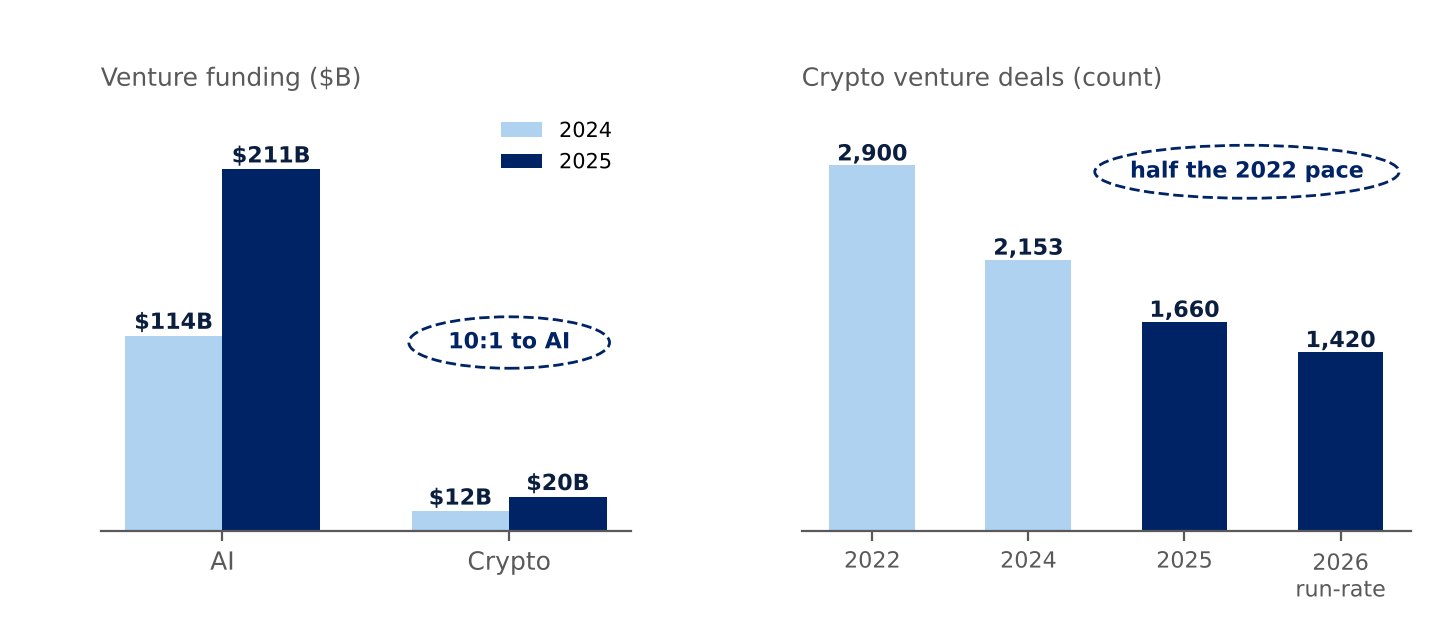
Sources: Crunchbase (AI-related funding, 2024 and 2025); Galaxy Research (crypto venture dollars and deal counts, 2022, 2024, 2025 and Q1 2026 annualised).
Fig. 1: Venture dollars went to AI ten to one in 2025, and crypto deal flow has halved since 2022
II. Fees Are Not Revenue
Across the ten largest fee generators in DeFi, gross fees over the last twelve months were $4.4 billion, but retained protocol revenue, the share that reaches the protocol or its tokenholders after liquidity providers and depositors are paid, was $1.7 billion, and the gap between the two is where the price action has been.4 Hyperliquid retained 86% of the economic value it generated and returned $640 million of it through buybacks; Pump.fun converted a third of its fees into buybacks; Uniswap generated $618 million of fees and, until this year's fee switch, token holders retained none of it. A protocol now earns a valuation when it retains revenue, returns it, and grows it faster than its own emissions. Revenue without growth gets a low ceiling, growth without retention gets a narrative multiple that can vanish in a quarter, and neither on its own is enough.
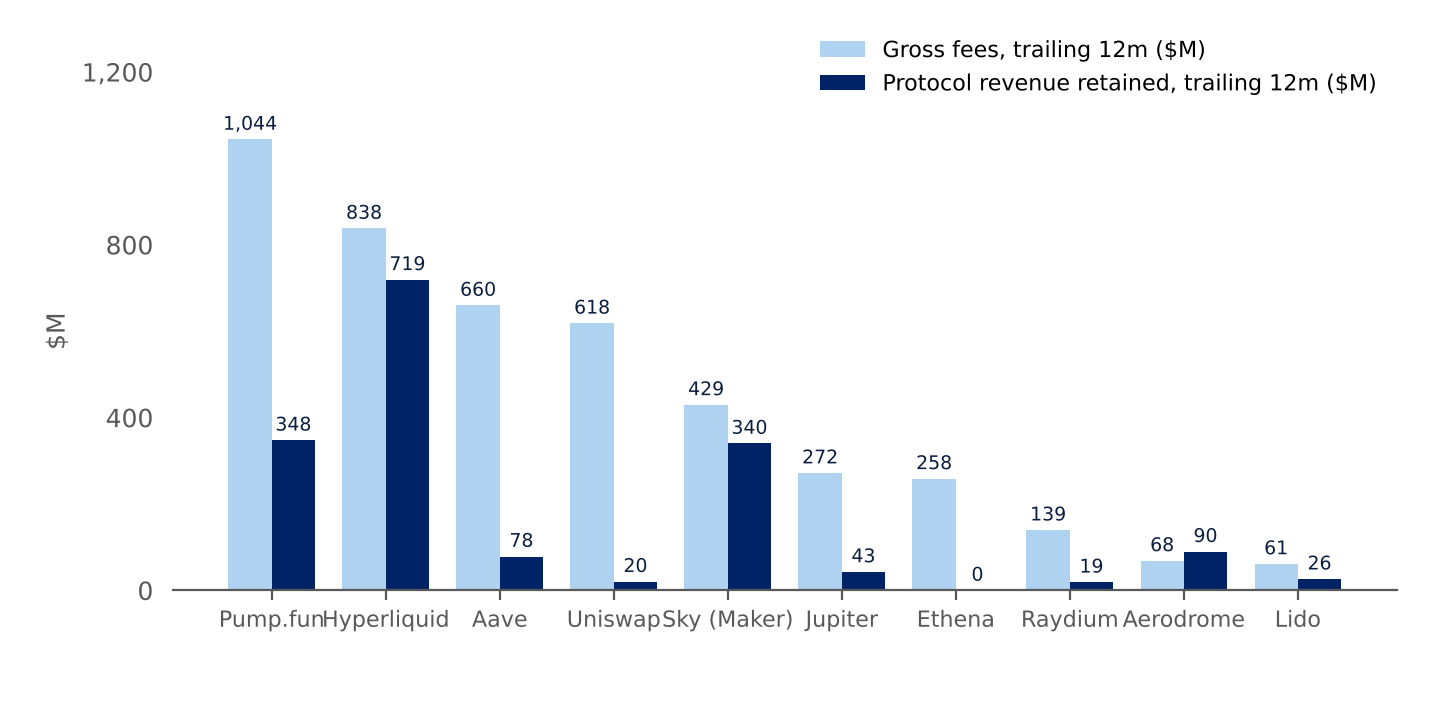
Sources: Artemis, trailing twelve months to 30 Sep 2026; Hyperliquid per hl.eco income statement to 12 Oct 2026; Sky shown net of savings-rate payouts; Aerodrome revenue exceeds fees because it includes voting incentives paid to veAERO holders; Ethena shown at zero as its income is paid to sUSDe holders and its reserve fund rather than retained for ENA holders. Revenue is fees retained by the protocol or its tokenholders.
Fig. 2: Fees are not revenue, and retention is what separates the ten largest DeFi fee generators
III. The Eleven-Person Exchange
Last year we described Hyperliquid as operating on an entirely different cost and efficiency curve from the centralised exchanges, and this year we can put numbers on it. Coinbase produced $6.3 billion of revenue over the last four reported quarters with 4,988 employees and $1.1 billion of sales and marketing spend.5 Hyperliquid produced $719 million of revenue, after builder and deployer shares, with eleven people and no marketing budget, and returned almost all of it to the token. On revenue per employee the gap is roughly fifty to one. The comparison measures operating leverage rather than equivalent profitability, since Coinbase runs a broader regulated business, but it is the ‘innovative management paradigm’ we flagged in 2025 made visible in the income statement, and it is why the market values the lean, revenue-retaining protocol on earnings while it still argues about multiples for everything else. Its Monday event, the largest and best-run of the week, felt like the real main stage.
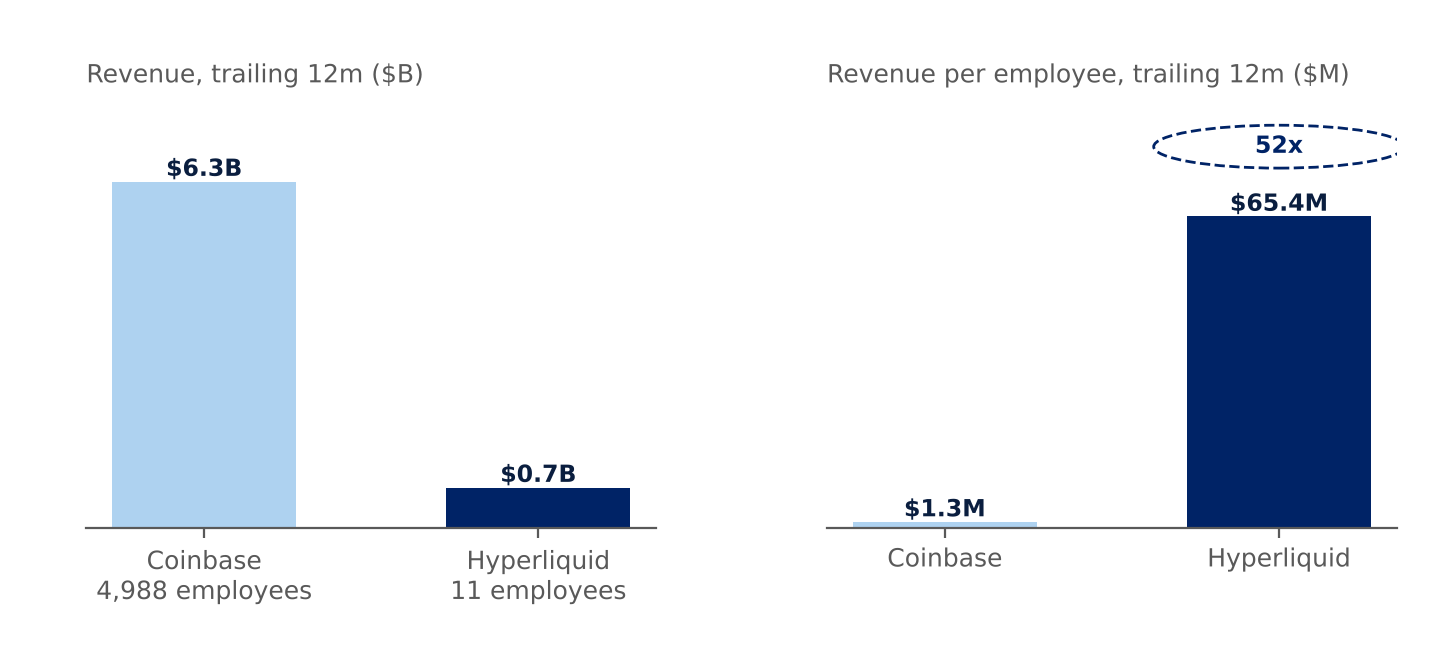
Sources: hl.eco income statement (Hyperliquid, trailing twelve months to 12 Oct 2026); Coinbase SEC filings via Artemis, Q3 2025 to Q2 2026. Coinbase headcount at 31 Mar 2026; Hyperliquid headcount per public reporting.
Fig. 3: Hyperliquid generates roughly fifty times Coinbase's revenue per employee
IV. Four Kinds of Token
Set aside the names with nothing behind them and the investable liquid market sorts into four groups. The first is the cash-rich legacy project, with a strong raise or treasury and no market-cap management at listing. Plasma (XPL), Zama (ZAMA) and Monad (MON) came up most, and interest has picked up because they are the natural beneficiaries of any broad risk-on move. The second is real revenue with buybacks, where Hyperliquid (HYPE), Pump.fun (PUMP) and Lighter (LIT) are the clearest cases, and a revenue screen turns up more. The third is the DeFi old guard, Uniswap (UNI), Aave (AAVE) and ether.fi (ETHFI), where conviction is steady rather than exciting and the businesses compound. The fourth is infrastructure built for the future. Zcash (ZEC) is a store-of-value hedge alongside Bitcoin, drawing flows because it aims to answer privacy and quantum risk, questions legacy chains have yet to solve; Near (NEAR) is building the rails for AI, cross-chain settlement and wallets; and Bittensor (TAO) and Pearl (PRL) are building the ecosystem for decentralised AI. What the first three share is a balance sheet, a cash flow or both, and the fourth a claim on problems the rest of the industry has not solved; the rest of the market has yet to give the marginal buyer a reason to show up. The digital-asset-treasury companies now forming around HYPE, NEAR and ZEC, listed vehicles that hold the token so that institutions can own it through an ordinary share, are a sign of where institutional demand is willing to go.
V. Tokenisation on Institutional Terms
Tokenisation is coming, but it will take longer than the industry hoped and its foundations are being laid on institutions’ terms. In practice the assets are issued by regulated firms rather than crypto start-ups and are usually packaged in a wrapper, a regulated fund or note that holds the underlying asset, so the institution buys a security it already understands and the token works in the background as the record of ownership, while large trades are done over the counter (OTC), negotiated privately between two parties rather than on a public exchange, which lets size move without moving the price. What is newer is that the same regulated tokens are starting to move on-chain and into retail hands. Binance launched its bStocks in June, backed one-to-one and trading around the clock, Backpack now offers SEC-registered tokenised shares on Solana, and since September Aave has accepted tokenised stocks as collateral for USDC loans on Base, turning a share into an asset that can be borrowed against at any hour.6 That is the step that matters, because a tokenised stock that can be traded, lent against and combined with other on-chain products does something a brokerage account cannot. The early demand shows in the data: tokenised stocks on public chains have grown from roughly $0.3 billion in mid-2025 to $3.3 billion today, about ten times in fifteen months, and the number of tokenised stocks on-chain has risen from under 200 to more than 5,000.7 The plumbing is largely built, and Franklin Templeton and Nasdaq were both on stage making the cost and settlement case; what remains is to show that tokenised products create new demand rather than simply moving existing assets onto new rails. Retail take-up is the first sign that they can, though at $3.3 billion tokenised stocks remain small next to the equity markets they draw on, and the build-out will be measured in years rather than quarters.
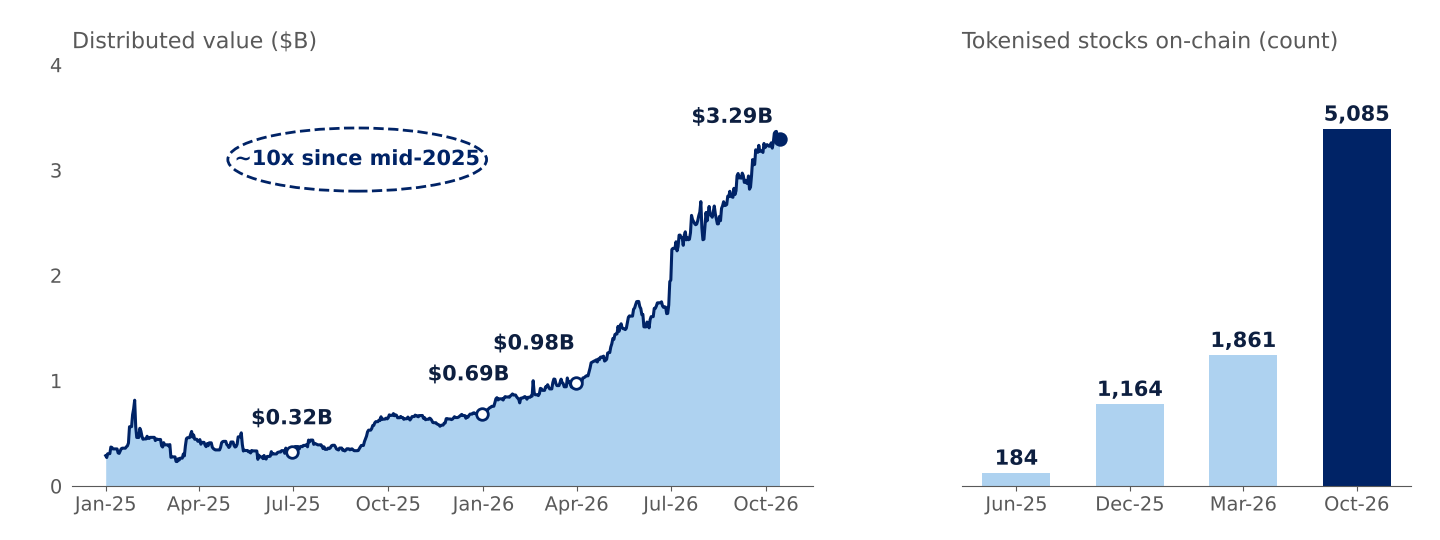
Sources: RWA.xyz tokenised-stocks data export, daily distributed value to 14 Oct 2026; count is stocks with positive on-chain value.
Fig. 4: Tokenised stocks have grown tenfold since mid-2025, from a small base
VI. Selection, Not Exposure
Taken together, the shape of this market is the mirror image of the one in which most of the industry was formed. Bitcoin and Ethereum are down on the year, while most of the names that recurred in conversation are up by multiples.8 This is not a beta market but a dispersion market, and dispersion is the raw material of a long/short mandate. Owning the index this year meant owning the drawdown in the majors and missing the names that paid, a harder market than the one long-only capital was built for and a considerably better one for a manager whose job is selection. Volatility tells the same story. As institutional capital deepens, volatility in the majors is drifting towards traditional-market levels, though individual names can still move sharply in both directions, and one of the more telling remarks of the week was that the most consistent return of the last five years has come from selling volatility into spikes rather than owning direction.
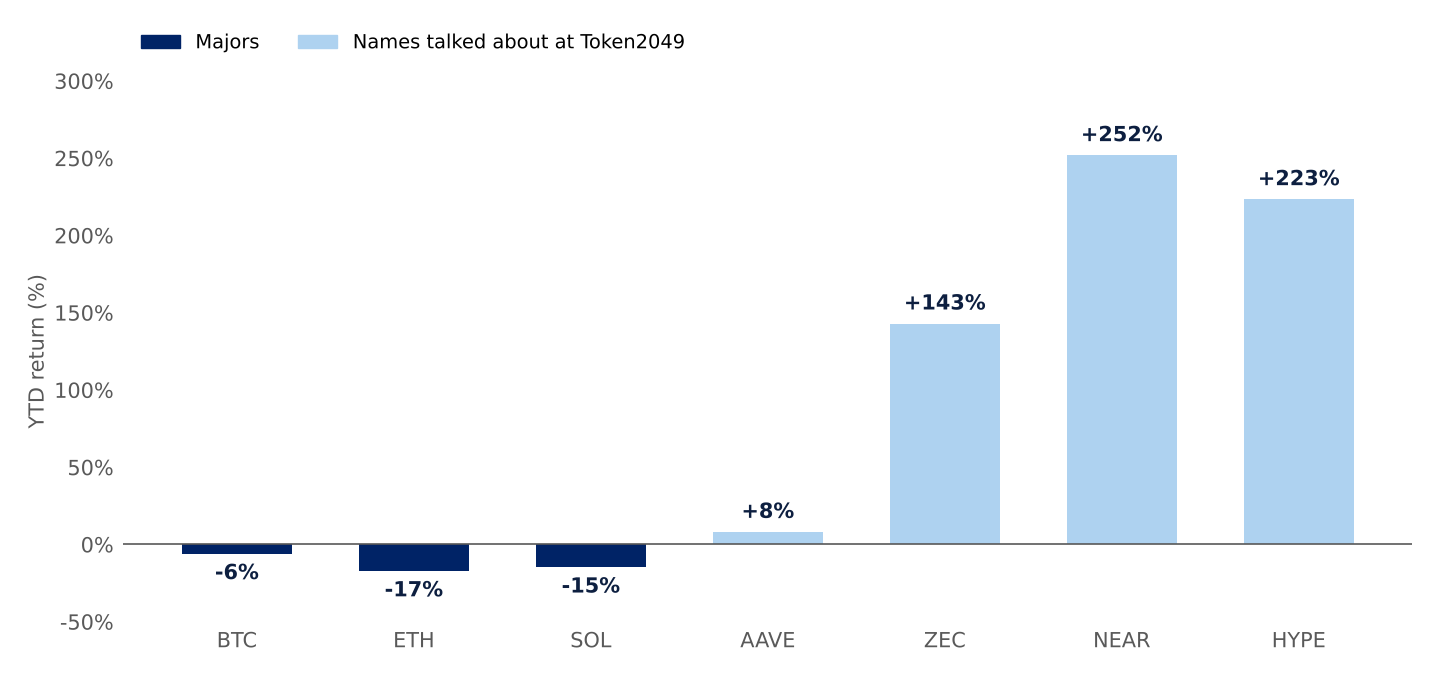
Sources: CoinGecko, 31 Dec 2025 close (00:00 UTC, 1 Jan 2026); CoinMarketCap, 15 Oct 2026. Selected examples, not an investable index or Privatus performance.
Fig. 5: Most of the names on everyone's lips are up multiples; the majors are down on the year
VII. The Privatus Mandate
A market that pays for revenue, retention and growth, and marks down everything else, rewards selection, timing and discipline over exposure. Our dual mandate exists for exactly this environment, which means being long the structural winners whose cash flows and token models the market is finally pricing, short of, or absent from, the names whose valuations have run ahead of the growth required to justify them, and patient on the majors that the room has forgotten. Conviction is no longer scarce in this market; conviction at a sensible price is, and we are not willing to pay up for the other kind. Our read from Singapore is neither euphoric nor bearish. The industry is more mature and the opportunity set is narrower, and that combination favours selection over exposure.
Notes
1 Conference observations, attendance, positioning and sentiment reflect the Privatus team’s first-hand experience at Token2049 Singapore, 7–8 October 2026. They are qualitative and not a statistical survey.
2 Token2049, announcement of a New York edition in June 2027, October 2026.
3 AI venture funding: Crunchbase, “Global Venture Funding In 2025 Surged As Startup Deals And Valuations Set All-Time Records,” 7 January 2026. Crypto venture dollars and deal counts: Galaxy Research, quarterly crypto venture capital reports, 2022 to Q1 2026. The 2026 deal count annualises Q1 and is not a full-year forecast.
4 Gross fees and protocol revenue: Artemis, trailing twelve months to 30 September 2026; Hyperliquid per the hl.eco income statement to 12 October 2026. Protocol revenue is fees retained by the protocol or its tokenholders. Sky is shown net of savings-rate payouts; Aerodrome revenue includes voting incentives paid to veAERO holders; Ethena’s income is paid to sUSDe holders and its reserve fund.
5 Hyperliquid: hl.eco income statement, trailing twelve months to 12 October 2026; headcount and marketing spend per public reporting. Coinbase: SEC filings via Artemis, Q3 2025 to Q2 2026; headcount at 31 March 2026. The comparison measures operating leverage, not equivalent profitability.
6 Binance, “Binance Exchange Launches bStocks Tokenized Securities,” 12 June 2026; Backpack Securities, tokenised US equities issued with Superstate on Solana; Aave V4 on Base, Coinbase-issued tokenised stocks accepted as USDC collateral from 25 September 2026.
7 Tokenised stocks: RWA.xyz, daily distributed value to 14 October 2026; count includes stocks with positive on-chain value.
8 Year-to-date returns: CoinGecko closing prices at 31 December 2025 (00:00 UTC, 1 January 2026) and CoinMarketCap prices on 15 October 2026. Selected examples only; not an investable index or Privatus performance.
Data-provider dashboards update continuously and may differ from the figures shown, which reflect the dates stated.
Disclosure
This document is published by Privatus Capital Ltd. for informational purposes only and does not constitute investment advice, an offer to sell, or a solicitation of an offer to buy any security or digital asset. It is not directed at any person in any jurisdiction where such distribution would be unlawful. The views expressed are those of the Fund as of the date of publication and are subject to change without notice. Digital assets are highly volatile and may result in total loss. Past performance is not indicative of future results. The Fund, its affiliates, and their principals hold or may hold positions in the digital assets and securities discussed herein and may buy or sell them at any time without notice. This document contains forward-looking statements, including projections, estimates, and target outcomes, that are inherently uncertain and subject to change; actual results may differ materially, and no representation is made that any such statement will prove correct. Certain information is derived from third-party sources believed to be reliable, but its accuracy and completeness are not guaranteed and have not been independently verified. Nothing herein should be relied upon as the basis for any investment decision, and readers should conduct their own analysis and consult their own financial, legal, and tax advisers.