
The loudest narrative in digital assets this year has declared that Bitcoin's (BTC) dominance is finally over. And for a moment, the evidence was compelling. At the peak of the rotation, the divergence was stark: Hyperliquid (HYPE) surged over 160% year-to-date, and Zcash (ZEC) posted a 1,200% trailing twelve-month return. Meanwhile, BTC suffered a -40% structural drawdown, carving out a four-month low on the back of multiple billion-dollar liquidation days.1 From this, the conclusion followed fast: "the industry has matured, earnings-bearing tokens deserve to trade on their own merits, and measuring crypto against BTC is a relic."
But the premature victory lap looks short lived. In the weeks since, HYPE's outperformance has compressed to under 120%, ZEC has retraced toward 700%, and the rotation's flagship names have broadly retreated from their highs. The pattern is familiar. This was the third declared "decoupling" in crypto history, and like the two before it, the illusion faded almost as soon as it became consensus.
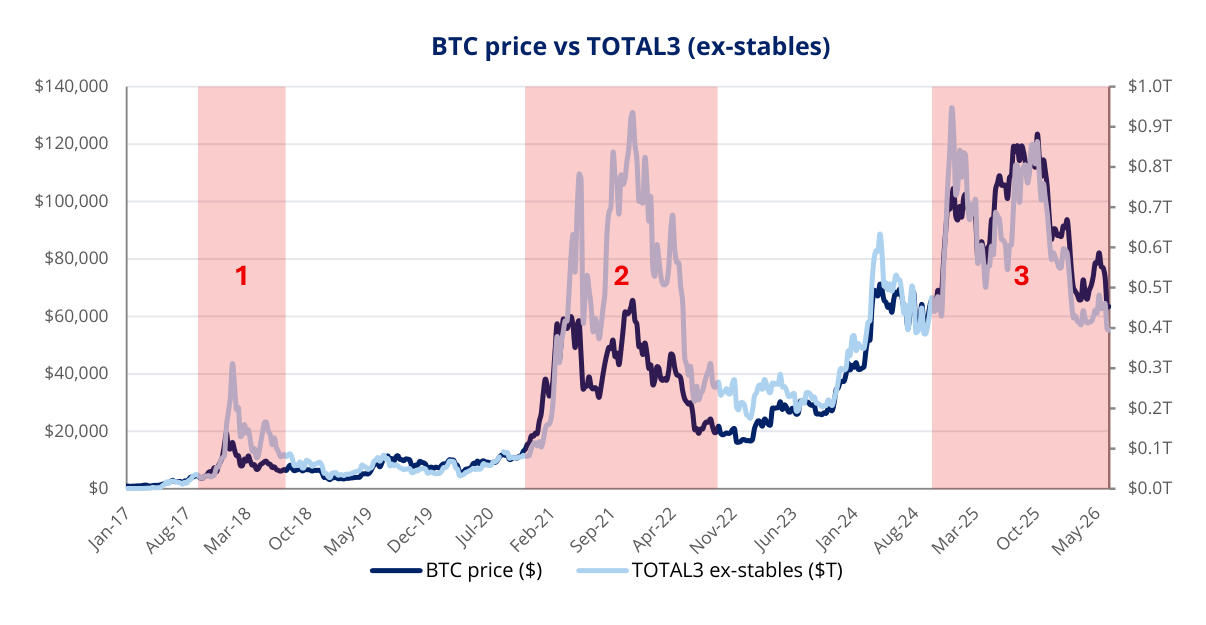
Sources: TradingView (CRYPTOCAP:BTC, CRYPTOCAP:TOTAL3).
Fig. 1: BTC price vs the rest (TOTAL3), 2017 to 2026.
The Fund owns some of the strongest assets in this rotation, and our thesis relies on their eventual fundamental independence. However, a vocal faction of the market has misdiagnosed the mechanics of this separation. They root for BTC to fall, viewing its drawdown as the catalyst for altcoins to break free. We share the desire for uncorrelated returns, but we reject the premise. A structural altcoin breakout built on a collapsing BTC at the market's current maturity is a mirage. Historically and structurally, the long tail inevitably converges back to the foundation it sought to escape.
The strongest argument for decoupling is based on valuation: a token generating cash flows deserves to re-rate on its earnings, while BTC, a pure store-of-value asset, operates on a different paradigm. We agree these are distinct assets. But framing this purely as a valuation exercise misses the point entirely. The critical question isn't how these assets should be valued relative to one another. The question is where the capital that buys either of them actually comes from.
I. Where the Capital Comes From
Our disagreement with the decoupling camp is not about whether these assets have independent value; it is about the sequence in which that value gets unlocked. But the industry routinely ignores an inconvenient reality: almost the entire capital base and innovation layer of this asset class was, and largely still is, capitalized by Bitcoin's success. Bitcoin acts as the hard money of the internet and the monetary base of the digital economy. Its expansions create the wealth that flows outward and down the risk curve, into altcoin portfolios, venture balance sheets, and nascent markets.
The flow runs through four channels:
- It generates the wealth. BTC currently holds roughly $1.07 trillion in realized cap2 (the value of all BTC priced at the moment each coin last moved on-chain, a proxy for the capital actually committed to the network). The unrealized gain on that base is the primary engine funding rotations into riskier, earlier-stage assets. While this "wealth effect" will dilute as the broader market matures and assets earn their independence, the ecosystem still relies on BTC to reach escape velocity.
- It opens the door. External capital tends to meet crypto through Bitcoin. The spot ETF complex is proof, drawing over $54 billion in net inflows since its January 2024 launch.3 It is the front door: most institutions establish a BTC position before deploying capital further out the risk spectrum.
- It funds the build. Bitcoin's past expansions directly capitalized the infrastructure we trade today. Crypto venture funding peaked at $33 billion in 20214 on the back of that cycle's success, and many of the investors and treasuries bankrolling new protocols remain heavily reliant on BTC.
- It captures the attention. Bitcoin's mainstream milestones are the category's top-of-funnel marketing, generating the headlines that pull successive waves of attention, talent, and capital into the space. The rest of the ecosystem is simply what they discover once they arrive.
It is one thing to want the ecosystem to be independent of Bitcoin, and another to invest as though it already is. When the monetary base expands, the quality portion of the stack will gain the momentum required to break free. With BTC still commanding ~58% of total market capitalization, hoping to decouple by shrinking the pie ignores a simpler reality: the long tail thrives when the foundational liquidity pool is growing.
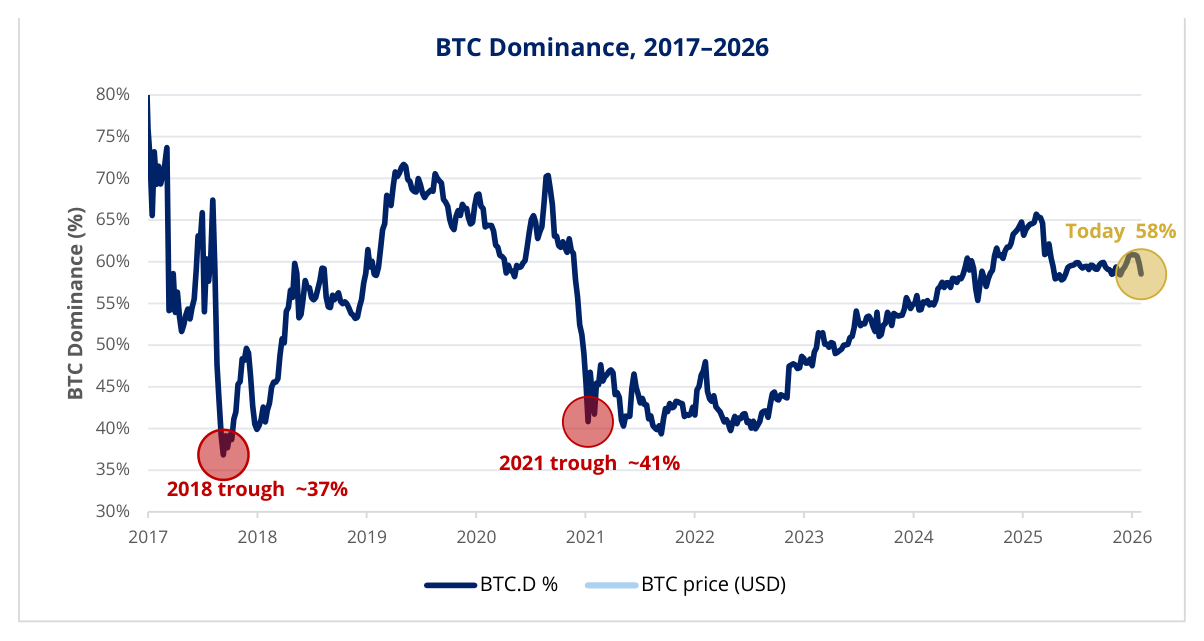
Sources: TradingView (CRYPTOCAP:BTC.D).
Fig. 2: Bitcoin dominance (BTC share of total crypto market capitalization), 2017 to 2026.
II. The Architecture of Dependence
The same plumbing that distributes wealth outward during an expansion forces it back in during a contraction. Altcoin correlation to BTC is not nostalgia or psychology; it is structural. The broader digital asset market operates under financial conditions that Bitcoin actively dictates.
- It dictates credit availability. BTC remains the primary collateral layer undergirding the ~$67 billion CeFi and DeFi lending markets. When BTC draws down, loan-to-value (LTV) ratios tighten system-wide.5 Margin calls trigger, borrowing capacity evaporates, and market makers pull resting liquidity from the books they quote. Liquidity drains from the thinnest order books first, precisely why altcoins suffer the most violent contractions during the exact drawdowns from which they claim to be decoupled.
- It defines the macro beta. Bitcoin is the asset class's ultimate barometer for global liquidity and the cost of capital. It reprices immediately on shifts in central bank rhetoric, well before policy is enacted.6 Every digital asset downstream inherits that volatility.
- It drives margin and liquidations. Perpetual futures, which command the bulk of industry volume, are heavily cross-margined against majors like BTC. A sharp flush in BTC does not prompt the long tail to sell; cross-margin liquidates it outright. This mechanical cascade routinely drives altcoins down in multiples of BTC's own decline.7
This role defaults to BTC because of a premium that short-term rotations consistently fail to price: absolute predictability. Almost every other token carries mutable terms. Emissions schedules are rewritten, token unlocks are moved, and governance votes or core teams can alter supply dynamics overnight. Bitcoin's monetary policy cannot be renegotiated. That immutable certainty is exactly what allows the rest of the market to underwrite risk against it.
The industry's long-term dream is for these financial primitives to migrate away from Bitcoin, and emerging market-structure legislation, the Digital Asset Market CLARITY Act, is designed to enable exactly that. But an honest read of the market's current architecture proves none of them have quite yet.
III. The Plumbing of a Breakout
Hyperliquid is the consensus case study for the decoupling narrative, and it remains one of the Fund's core positions. The platform earned its leadership through flawless execution, exactly the kind of breakout we champion: a protocol compounding value on its own merits. Because HYPE held its ground while BTC drew down, the market reads it as proof that a premier altcoin can finally escape Bitcoin's gravity. That reading is premature, and the venue's own plumbing shows why.
Initial price resilience is not yet independence, and the venue's own tape settles the question. Since its Q3 '25 peak, absolute volume on Hyperliquid has contracted by more than 40%. The decline came even after an aggressive pivot into commodities, indices, and equities grew TradFi volume nearly nine-fold, to 32.1% of the mix. The drag traces back to the majors: BTC, Ethereum (ETH), and Solana (SOL) still clear roughly 75% of native crypto volume, so their drawdown suppressed the venue's activity and the fee base beneath it. This proves that even the strongest platform still moves with the assets it trades.
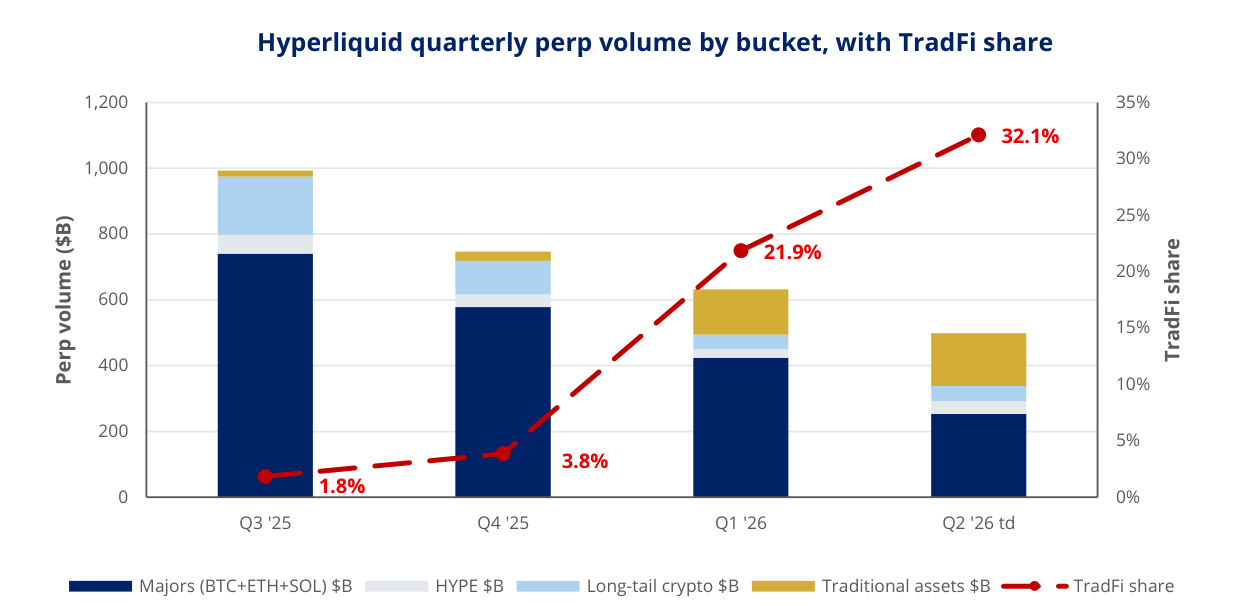
Sources: Artemis; Dune, June 4, 2026.
Fig. 3: What Actually Decoupled at Hyperliquid.
The stronger version of the bull case looks past the volume and argues from fundamentals instead: judge HYPE on its own revenue and buybacks, and it already stands alone. That independence is contingent in its origins and cyclical in its cash flows, which is exactly why HYPE confirms our thesis rather than refutes it. HYPE's real moat is its liquidity, and that liquidity was seeded by crypto's own users and capital, not by the TradFi volume it now courts. Because fees fund the token buybacks, the value accrual that bulls point to still moves with the cycle. When the majors draw down, fees compress and the buyback bid thins with them. TradFi is the one stream genuinely independent of the cycle, but even at nine-fold growth, it cannot yet offset the decline in everything else.
Hyperliquid perfectly validates our thesis that no altcoin truly decouples during a localized bear market. Although its staggering growth in traditional finance will eventually allow it to trade entirely on its own merits, the protocol currently still relies on broader crypto volume. This means a rising Bitcoin is a necessary tailwind that draws in the capital, liquidity, and trading demand required to compound HYPE's moat. We are investing in its future independence, and impending regulation will likely accelerate that reality, but this separation remains a sequential process. Because we are still in the early innings of this transition, HYPE's trajectory is tethered to Bitcoin, making a thriving overall market base the essential foundation it needs to lead the next breakout.
IV. Rotation Is Not Regime Change
Genuine market decoupling is a balance-of-flow statement. For altcoins to achieve permanent price independence from BTC, net external capital must enter the ecosystem to absorb them. Outside of isolated instances like the early institutional bid for ETH, SOL, and more recently HYPE, that capital does not exist yet. Aggregate stablecoin supply, the primary fiat on-ramp for the digital asset class, plateaued through the first half of the year and is now contracting, sitting near $315 billion.8 Instead of entering crypto, the marginal external dollar is being diverted into the largest corporate infrastructure capex cycle in history. Hyperscalers spent over $400 billion on artificial intelligence infrastructure in 2025 and have projected between $630 billion and $725 billion for 2026. This pool is roughly half of BTC's entire market capitalization. That same appetite is now drawing capital into a wave of mega-cap listings, starting with SpaceX.9 Institutional BTC allocators can rotate into that equity trade, and recent spot ETF outflows reflect that migration. Conversely, most altcoin holders lack an easy exit architecture into AI equities. Consequently, many are forced to recycle existing capital within a closed, player versus player liquidity pool.
V. The Zero-Sum Delusion
A closed liquidity pool behaves in highly volatile, predictable ways; lacking structural depth, a single large participant can move the entire market by sheer force, capturing outsized profits at the expense of passive holders. In May, Arthur Hayes publicly championed HYPE, NEAR, and ZEC as the cycle's "holy trinity." By early June, he had completely unwound his exposure within a 48-hour window, liquidating HYPE and NEAR on June 4 and ZEC on June 5. On his exit alone, with absolutely no project-level changes, HYPE and NEAR fell by 9% and 20% respectively, while ZEC contracted even more sharply following a concurrent network vulnerability disclosure.10 While this is a liquidity and depth issue an asset class supported by an authentic, institutional outside bid does not suffer sudden, double-digit drawdowns on the whim of a single market participant.
This underlying fragility is precisely what makes the decoupling camp's core thesis so dangerous. A vocal segment of the industry is actively rooting for a severe Bitcoin drawdown to trigger a forced MicroStrategy liquidation, operating under the delusion that it will somehow liberate their altcoin portfolios. The mechanics do not support the hope, and MicroStrategy's recent conduct proves it.
In late May, the company sold 32 BTC for approximately $2.5 million, its first net disposal since 2022. While critics labeled this the beginning of the end, the data reveals a calculated, discretionary move. Executed above cost basis, the sale represented less than four-thousandths of a percent of their total treasury. It was a clear demonstration of capital management: a deliberate signal that MicroStrategy can comfortably service its STRC preferred stock dividend through tiny, managed distributions rather than a forced market liquidation.
That a minor transaction can provoke a synchronized contraction across the entire asset class underscores how fragile and sentiment-driven this closed pool remains. Our internal analysis confirms that a systemic margin call is a far stretch; MicroStrategy's core Bitcoin holdings are entirely unencumbered, and their convertible notes are completely free of restrictive liquidation covenants. The live risk is not a forced liquidation cascade, but rather a regime shift where the market's premier structural buyer code-switches into a structural seller.
Were a black swan liquidation ever to occur, this is proof, it would not free alternative assets. It would transmit instantly through every credit, margin, and collateral channel in the system, burying the long tail. To celebrate the potential collapse of the market's foundational reserve is the zero-sum delusion at its purest: it is choosing to drown in a smaller pool and calling it liberation.
VI. Crypto's 1971
Bitcoin continues to behave exactly like the monetary base it is. This dynamic mirrors how any domestic economy interacts with its reserve asset, making the classic gold standard the correct historical analogy. The global economy did not abandon gold because gold failed; it transitioned because the underlying commercial economy outgrew the fixed peg. The dollar economy matured over decades, and 1971 merely formalized a reality that had already arrived.
The digital asset class will eventually experience its own 1971, and the catalyst is already visible. Comprehensive regulatory clarity is the sole mechanism that will allow tokens to be valued on their individual cash flows and valuation mechanics rather than as a high-beta proxy for the Bitcoin trade. While legislative efforts are advancing in Washington, full implementation and subsequent rulemakings are projected to stretch well into 2027.11 We see the structural foundations being laid today through scaling stablecoin settlements on Ethereum and Solana, protocols generating sustainable fee revenue, and traditional financial institutions licensing digital asset infrastructure.
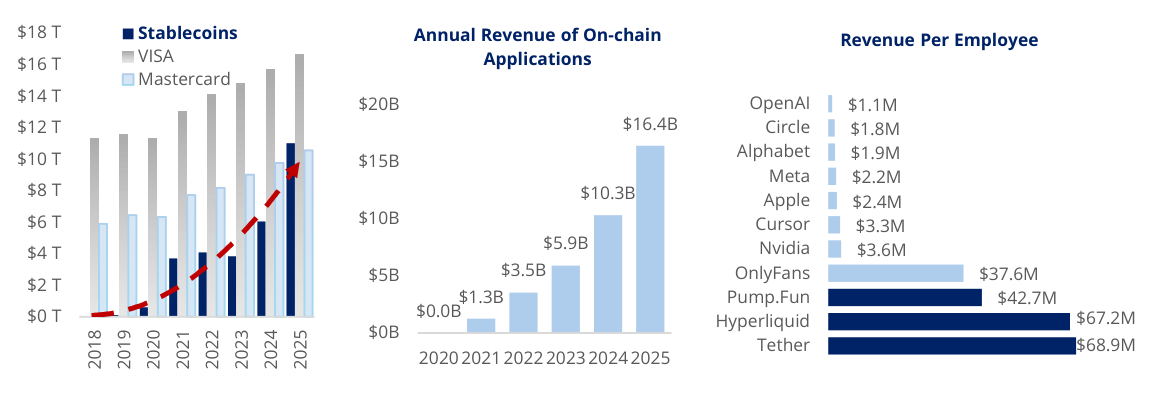
Sources: Allium and DeFiLlama.
Fig. 4: Stablecoin transaction growth leads to profitable businesses.
Our Fund is heavily deployed into this secular shift, which we expect to accelerate quickly. However, declaring that this decoupled future has already arrived in the middle of a cyclical drawdown, while market collateral and fiat gateways remain wired to Bitcoin, is the equivalent of calling for 1971 from the depths of the 1950s.
Analytical discipline requires defining what would invalidate this thesis. We look for altcoin market capitalization to expand through a sustained Bitcoin drawdown, accompanied by expanding stablecoin supply, ETF inflows broadening beyond Bitcoin, and an altcoin aggregate printing new highs. True independence requires a fresh, external bid, not just internal capital rotation.
The path to that decoupling demands education and fresh external capital, not cannibalizing the long tail in a localized bear market before the legal architecture is even codified. As a fund, we win when alternative assets win, and we hold the most resilient protocols today precisely because their upside in a mature market is entirely asymmetric. Wanting to differentiate from passive Bitcoin exposure is no reason to root for its collapse. Subverting the market's primary reserve asset simply destroys the wealth effect that capitalizes the rest of the ecosystem. We are on the cusp of a transition that Bitcoin ultimately funds. Once Bitcoin regains its footing, it requires no dramatic breakout; a slow, steady expansion of the base is more than enough to give high-merit altcoins the runway to scale on their own fundamentals.
Why not simply hold Bitcoin, or wait for a definitive breakout before moving further out the risk curve? The answer is the brutal velocity of crypto markets. By the time a regulatory catalyst or macro shift is obvious enough to feel safe, the trade is already over. The protocols building genuine moats and printing cash flows will have already violently revalued. Bitcoin is the baseline beta that ensures survival; these select assets are the engines that generate actual outperformance, and their underlying value is compounding in the background right now. The true discipline of this environment is not waiting for the foundation to clearly expand, but accumulating the assets poised to outpace it the moment it does. The base will expand, and decoupling will follow. The only question is whether an allocator secures their position before that repricing or pays a massive premium to the funds that did.
Footnotes
1 Liquidation total confirmed via CoinGlass; CoinDesk, June 4, 2026.
2 Glassnode, realized capitalization, June 8, 2026 (~$1.07T).
3 DeFiLlama, ETF net flows; cumulative +$54.31B through June 3, 2026.
4 Galaxy Research, via Blockworks.
5 Galaxy Research, Q1 2026 leverage report ($67.4B, off a $78.7B peak).
6 BTC reprices intraday on scheduled Fed communication: mean absolute hourly returns rise from 0.66% in the hour before the FOMC statement to 1.25% in the announcement hour, with USD volume up ~2.5–3×. "Scheduled FOMC Statements and Intraday Macro Event Risk in Cryptocurrency Markets," Finance Research Letters, 2026.
7 Oct. 10, 2025 deleveraging: BTC/ETH fell 12–17% while the average altcoin fell ~33% in the worst window, the long tail liquidated through cross-margin collateral sales. insights4vc, "Inside the $19B Flash Crash."
8 Artemis, aggregate stablecoin supply; $317.3B as of June 8, 2026, contracting toward $315B.
9 Company FY2025 filings and FY2026 capex guidance (Microsoft, Amazon, Alphabet, Meta, Oracle); 2026 aggregate per Bloomberg and Morgan Stanley consensus.
10 HYPE fell ~9% and NEAR ~20% on his June 4, 2026 exit (on-chain records / contemporaneous coverage).
11 Congress.gov, CLARITY Act legislative status.
Disclosure
This document is published by Privatus Capital Management for informational purposes only and does not constitute investment advice, an offer to sell, or a solicitation of an offer to buy any security or digital asset. It is not directed at any person in any jurisdiction where such distribution would be unlawful. The views expressed are those of the Fund as of the date of publication and are subject to change without notice. Digital assets are highly volatile and may result in total loss. Past performance is not indicative of future results. The Fund, its affiliates, and their principals hold or may hold positions in the digital assets and securities discussed herein and may buy or sell them at any time without notice. This document contains forward-looking statements, including projections, estimates, and target outcomes, that are inherently uncertain and subject to change; actual results may differ materially, and no representation is made that any such statement will prove correct. Certain information is derived from third-party sources believed to be reliable, but its accuracy and completeness are not guaranteed and have not been independently verified. Nothing herein should be relied upon as the basis for any investment decision, and readers should conduct their own analysis and consult their own financial, legal, and tax advisers.